1. Executive Industry Whitepaper: Navigating Global Orthopedic Sourcing
The global orthopedic implants market is experiencing an unprecedented structural shift. Driven by aging demographics, expanding access to healthcare in emerging economies, and accelerated adoption of minimally invasive surgical (MIS) techniques, procurement directors and medical device distributors are faced with complex decisions. Downloading a manufacturer's product catalogue is no longer a simple transactional step; it is the starting point for evaluating a long-term supply chain partner capable of ensuring biocompatible material integrity, regulatory compliance, and consistent delivery schedules.
As a leading orthopedic implant manufacturer and exporter, our engineering facilities bridge the gap between high-precision OEM/ODM production and cost-effective distribution. Procurement teams must scrutinize prospective suppliers based on rigid Search Quality Rater guidelines—verifying real-world manufacturing Experience, metallurgical Expertise, regulatory Authoritativeness, and certified Trustworthiness (E-E-A-T). This whitepaper details the essential technical metrics, market evolutions, material sciences, and risk mitigation strategies required when downloading catalogues and selecting orthopedic manufacturing partners.
"True information gain in medical device procurement comes from understanding not just unit pricing, but the raw material certifications, machining precision tolerances, and regulatory documentation backing every surgical implant."
Metallurgical Integrity
Verification of ISO 5832-3 (Ti-6Al-4V ELI) and ASTM F136 implant-grade titanium standards. Every lot undergoes destructive tensile testing and microscopic phase analysis.
Regulatory Dossiers
Full CE Class III certifications, FDA establishment registrations, and ISO 13485 QMS documentation support seamless local registration for global importers.
OEM/ODM Prototyping
In-house 5-axis CNC Swiss automatic turning centers enable custom implant geometry modification, private label laser etching, and customized instrument kit assembly.
2. Development Trends in Modern Orthopedic Implants
The field of orthopedic implants is undergoing a technological renaissance. Manufacturers who fail to integrate advanced biophysical engineering into their standard catalogue lines risk obsolescence. When downloading catalog specifications, surgical purchasing committees should evaluate whether manufacturers are keeping pace with modern biomechanical developments:
A. Additive Manufacturing & 3D Printed Porous Structures
Direct Metal Laser Sintering (DMLS) and Electron Beam Melting (EBM) have revolutionized spinal interbody fusion cages and joint reconstruction components. By creating trabecular-like porous titanium structures with pore sizes ranging between 400 to 700 microns, 3D printing promotes rapid osseointegration through physical osteoconduction. This eliminates the interface shear failure often associated with traditional smooth coatings.
B. Carbon-PEEK & Bioresorbable Polymer Composites
Polyetheretherketone (PEEK), specifically radiolucent carbon-reinforced PEEK Optima, has emerged as the gold standard for trauma plates and spinal cages where post-operative artifact-free imaging (CT/MRI) is vital. Furthermore, bioresorbable magnesium-alloy and PLA-PGA bone tacks are reducing the necessity for follow-up implant removal surgeries in pediatric and sports medicine procedures.
C. Surface Engineering & Hydroxyapatite (HA) Nanocoatings
Surface modification plays a decisive role in long-term implant survival. Advanced micro-arc oxidation (MAO) combined with nanoscale Hydroxyapatite plasma spraying enhances early bone-implant contact (BIC). Furthermore, antimicrobial silver-ion vapor deposition is significantly lowering surgical site infection (SSI) risks in high-risk trauma and revision cases.
D. Anatomically Pre-Contoured Locking Plate Systems
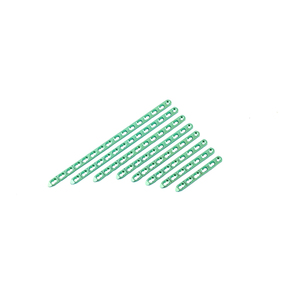
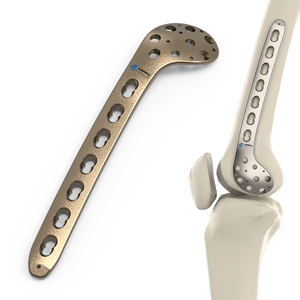
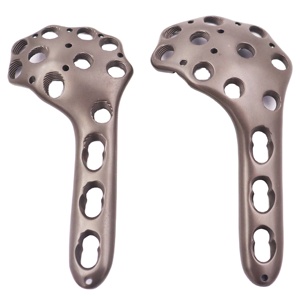
Standard flat compression plates require intraoperative manual bending, increasing stress concentration zones that lead to fatigue failure. Modern trauma catalogue offerings feature anatomically pre-shaped plates derived from vast 3D skeletal CT database modeling. This ensures flush periosteal seating, preserving microvascular perfusion while reducing operative time.
3. Future B2B Procurement Trends in Global Healthcare Supply Chains
Hospitals, government tenders, and independent distributors are revamping their purchasing strategies to mitigate supply chain disruptions. Procurement officers evaluating orthopaedic catalogue downloads should anticipate four macro trends defining 2025–2030 sourcing:
| Procurement Vector |
Traditional Procurement Model |
Future Trend (2025-2030 Model) |
Impact on Importers & Distributors |
| Order Minimums (MOQ) |
Rigid high volume per SKU (500+ units) |
Flexible Low MOQ & Mixed-SKU Bundling |
Reduces tied-up capital; allows broader inventory range for niche surgical sizes. |
| Supplier Vendor Count |
Fragmented sourcing across 10+ niche vendors |
One-Stop Consolidated OEM Manufacturers |
Consolidates shipping costs, unifies QMS compliance, and streamlines customs clearing. |
| Regulatory Risk Handling |
Basic material data sheet delivery |
Turnkey Technical Dossiers & MDR Support |
Ensures fast clearance with local regulatory authorities (FDA, EU MDR, PMDA, ANVISA). |
| Instrument Kit Matching |
Implants and tools sourced separately |
Integrated Implant-Instrument Tray Bundles |
Guarantees 100% mechanical compatibility, minimizing intraoperative driver slippage. |
Streamlining Sourcing via Integrated Catalogue Downloading
Leading global buyers now prioritize manufacturers that provide transparent, downloadable technical catalogues with clear dimensional CAD drawings, thread pitch specifications, and matched surgical instrument code listings. This digital transparency drastically reduces procurement lead-time, preventing ordering errors in complex spinal rod-screw systems and intramedullary nail locking configurations.
4. Corporate Manufacturing Strengths & Enterprise Excellence
When downloading our comprehensive orthopedic implant catalogue, you are connecting with a fully integrated medical device manufacturing facility designed to serve high-volume global markets without compromising quality control.
State-of-the-Art Production Facility
Spanning over 60,000 square meters, our production plant operates 24/7 with over 450 advanced machine tools, including Japanese Citizen 5-axis Swiss CNC turning lathes, DMG Mori milling centers, and high-precision Wire EDM units. We maintain a daily output of 20,000 finished components, ensuring rapid order fulfillment even during global supply shortages.
Rigorous R&D & Metallurgical Testing
Supported by a dedicated team of 70+ senior biomedical engineers and an ISO 17025 accredited laboratory. Every product design undergoes rigorous finite element analysis (FEA), dynamic axial fatigue testing, torsional strength evaluation, and biocompatibility assays in compliance with ASTM F136 and ISO 5832 specifications.
Complete Quality Assurance & Traceability
Our quality management system is certified to ISO 13485 standards and registered with the U.S. FDA. From raw titanium billet inspection to cleanroom gamma-sterilization barrier packaging, every single implant carries a unique laser-etched matrix code enabling complete lot-to-patient traceability.
Turnkey OEM & ODM Customization Services
We empower global medical device brands by providing full OEM/ODM services. From custom anatomical plate curvature development to specialized color anodization, custom packaging blister tray sealing, and localized language IFU printing, we deliver market-ready solutions tailored to your regional brand strategy.
5. Orthopedic Implant Procurement FAQ
Below are detailed answers to technical and logistical questions commonly submitted by medical device procurement officers, hospital purchasing boards, and regional distributors:
Q1: What quality certifications and regulatory dossiers are included with catalogue product orders?
All implants and instruments manufactured in our facilities comply with ISO 13485 Quality Management System standards and U.S. FDA establishment regulations. Upon catalogue inquiry or order placement, qualified distributors receive complete technical dossiers including Material Certificates of Analysis (CoA), Mechanical Test Reports (tensile, static/dynamic fatigue), ISO 10993 Biocompatibility reports, Gamma Sterilization Validation data, and CE conformity documentation to support local market registration.
Q2: How does your facility handle Low MOQ requirements for specialized or small-market distributors?
We understand that stocking full orthopedic product lines across various screw lengths, plate profiles, and nail diameters can strain working capital. We support low minimum order quantities (MOQ) and allow mixed-SKU ordering within single shipments. Importers can consolidate trauma locking plates, pedicle screws, intramedullary nails, and matching instrument trays into one combined export container.
Q3: What raw materials are utilized in your trauma, spine, and veterinary implant systems?
We strictly utilize certified implant-grade raw materials sourced from audited global suppliers. Our metal implants utilize Ti-6Al-4V ELI titanium alloy (ASTM F136 / ISO 5832-3), Grade 4 Commercially Pure Titanium (ASTM F67), and 316L Stainless Steel (ASTM F138). Non-metallic implants, such as spinal cages and suture anchors, utilize medical-grade PEEK Optima (Invibio) and bioresorbable polymers.
Q4: Can we request private labeling (OEM) and custom laser etching on implants and instrument boxes?
Yes. Our automated production line includes high-resolution fiber laser marking stations capable of etching your registered brand logo, SKU numbers, lot codes, and alignment indicators onto implants and surgical handles. We also offer custom-anodized color coding (gold, blue, green, magenta) for immediate intraoperative size identification.
Q5: Are surgical instrument sets included with implant catalogue downloads, or are they sold separately?
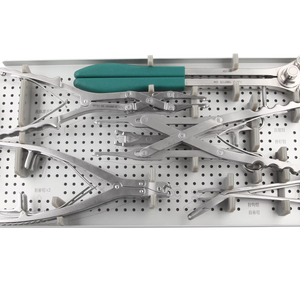
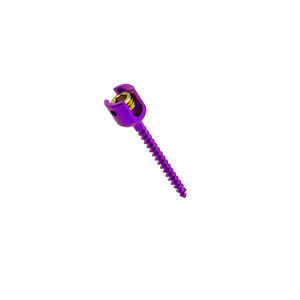
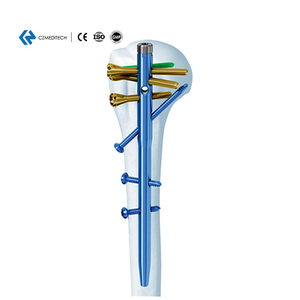
Every implant family showcased in our catalogue (e.g., 5.5/6.0 Thoracolumbar Pedicle Screw Systems, Distal Femoral Locking Plates, Intramedullary Nails) has a perfectly matched, ergonomically designed surgical instrument set. Trays can be ordered separately or bundled as complete surgical starter kits in anodized aluminum sterilization containers.
Q6: What is the typical lead time for catalogue catalog re-orders versus custom ODM prototype projects?
Standard catalogue items maintained in inventory typically ship within 7 to 14 working days. Custom OEM/ODM manufacturing projects—involving specialized CAD modification, prototyping, tooling setup, and pilot batch validation—generally require 30 to 45 calendar days depending on geometric complexity and regulatory testing requirements.
Q7: How do you ensure screw thread precision and prevent intraoperative stripping or driver cam-out?
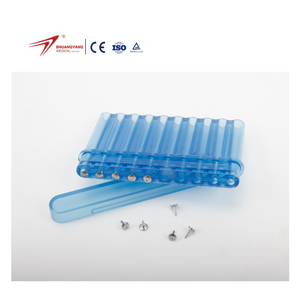
Precision is maintained through automated optical inspection systems and 100% thread gauge verification. Screw drive recesses (such as Torx, T15 cruciform, or hex) are machined with tight optical tolerances (+/- 0.005mm), ensuring positive driver engagement, minimal recess wear, and high torque transmission without cam-out risks.
Q8: How can distributors request evaluation samples prior to committing to large-scale procurement?
Qualified medical device distributors and hospital purchasing committees can apply for sample evaluation sets through our live consultation network. Evaluation samples allow surgical teams to inspect surface finish, assess screw-plate locking engagement, and test instrument balance in sterile workshop settings prior to bulk contract execution.