Featured Orthopedic Implants & Surgical Devices
Standardized Class I, II, and III medical devices manufactured under strict ISO 13485 quality protocols for worldwide hospital procurement and distribution networks.
Navigating the China Orthopedic Implants Supply Chain: Executive Sourcing Analysis
The global market for orthopedic implants—spanning trauma fixation, spinal reconstructive constructs, joint arthroplasty, and craniomaxillofacial (CMF) devices—is undergoing a structural transformation. International medical device importers, regional distributors, and hospital procurement groups are actively recalibrating their global supply chain strategies. As healthcare systems push for value-based care without compromising surgical efficacy, searching for top China orthopedic implants suppliers and exporters has evolved from a simple cost-reduction tactic into a comprehensive strategic initiative.
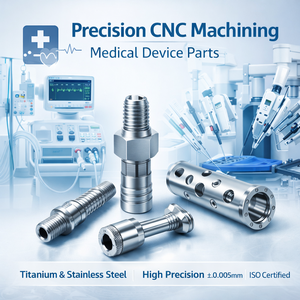
China's medical device manufacturing sector has matured past basic component duplication. Today, Tier-1 Chinese manufacturers operate ultra-modern production hubs featuring 5-axis Swiss-type CNC machining centers, additive manufacturing (3D printing lattice structures), ISO Class 7 cleanrooms, and automated co-ordinate measuring machine (CMM) quality validation lines. Furthermore, leading exporters align their Quality Management Systems (QMS) directly with international regulatory frameworks including ISO 13485:2016, US FDA 21 CFR Part 820, and European Union Medical Device Regulation (EU MDR 2017/745).
Information Gain Insight: Key Technical Requirements for Importers
When qualifying orthopedic exporters, professional buyers must look beyond catalog pricing. Essential baseline criteria include raw material certification (e.g., medical-grade Ti-6Al-4V ELI conforming to ASTM F136 or ISO 5832-3), micro-surface roughness metrics (Ra < 0.4 µm for friction contacts), static/dynamic fatigue testing reports (ASTM F1717 for spinal constructs; ISO 14801 for dental/small implants), and comprehensive lot traceability from ingot to sterile packaging.
In-Depth Technical Analysis of Core Orthopedic Lines
To make informed purchasing decisions, importers must evaluate product specifications against specific clinical surgical applications. Below is an engineering overview of key orthopedic device families currently exported by leading Chinese manufacturers.
Trauma Fixation Systems
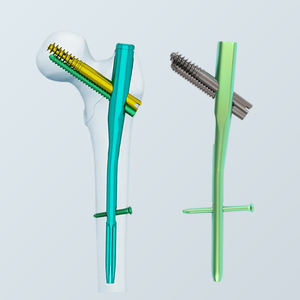
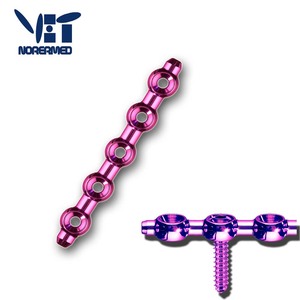
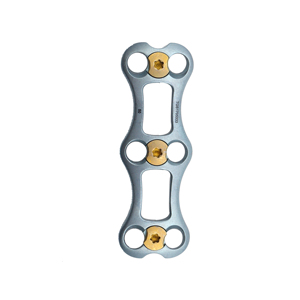
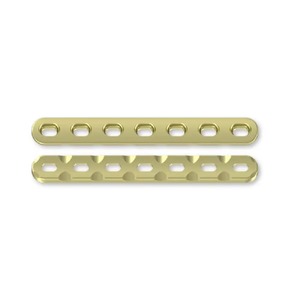
Encompassing locking compression plates (LCP), cannulated screws, and interlocking intramedullary (IM) nails (such as Proximal Femoral Nails PFNA and Intertan systems). Manufactured from Ti-6Al-4V ELI or 316L medical stainless steel. Features anatomical pre-contouring, limited-contact undersurface design to preserve periosteal blood supply, and standardized combi-holes accepting both cortex and locking screws.
Spinal Implant Platforms
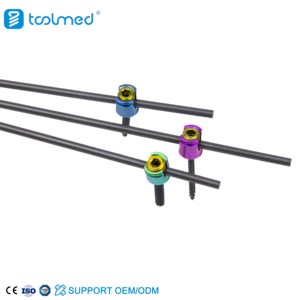
Including Anterior Cervical Plating (ACP) systems, Thoracolumbar Pedicle Screws (5.5mm/6.0mm rod platforms), PEEK Interbody Fusion Cages (PLIF, TLIF, ACDF), and 3D Printed Porous Titanium Cages. Pedicle screws incorporate dual-lead thread geometries for high pull-out strength in osteoporotic bone, combined with friction-fit polyaxial heads providing wide angulation capability.
External Fixation & CMF
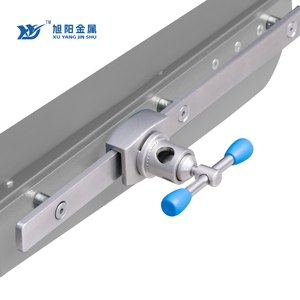
Square-hole and carbon-fiber rod external fixators engineered for high-energy open fracture management and limb lengthening. Accompanied by low-profile cranial plating, PEEK cranial repair plates, and maxillofacial micro-plates designed for micro-screw retention without soft tissue impingement.
Veterinary Orthopedics
Rapidly growing export segment featuring specialized SOP (Selective Osteosynthesis Plate) locking plates, TPLO/TTA cruciate ligament restoration systems, and canine/feline spinal stabilization rods. Designed to accommodate varying anatomical dimensions across companion and equine veterinary surgery.
Surgical Instrument Sets
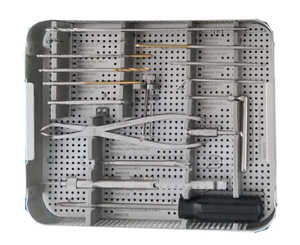
Every implant family requires matching instrumentation. Exporters supply color-coded, hard-anodized aluminum and stainless-steel instrument trays containing torque-limiting drivers, quick-coupling reamers, drill guides, and reduction forceps designed for tens of thousands of autoclave sterilization cycles.
Future Procurement Trends for Orthopedic Implants
Understanding long-term supply dynamics is crucial for procurement officers managing multi-year medical supply contracts. The following key trends are shaping the future of global orthopedic sourcing from Chinese manufacturers:
1. 3D Printing & Porous Titanium Adoption
Traditional machined solid implants are increasingly giving way to additive-manufactured (EBM/SLM) porous titanium constructs. These 3D printed implants replicate natural trabecular bone architecture (with 60–80% porosity and 300–500 µm pore sizes), promoting rapid bony ingrowth and eliminating the risk of surface coating delamination.
2. Mixed-SKU Bundling & Low MOQ Flexibility
To reduce capital lockup in inventory, international distributors are moving away from massive container-load single-SKU orders. Leading Chinese exporters now offer low Minimum Order Quantities (MOQs) with flexible mixed-SKU ordering, enabling buyers to import tailored assortments of plates, screws, nails, and cages in a single shipment.
3. Stringent Regulatory Harmonization
As national regulatory bodies align with International Medical Device Regulators Forum (IMDRF) guidelines, importers require full technical documentation packages. Top China suppliers now routinely provide complete ISO 13485 QMS documentation, FDA establishment registration numbers, Biocompatibility Evaluation Reports (ISO 10993), and EU MDR Technical Files.
4. Smart & Robotic-Navigation Compatible Tools
Surgical trends favor minimally invasive surgery (MIS) and computer-assisted robotic placement. Orthopedic implant manufacturers are updating driver interfaces, navigation trackers, and instrument geometry to seamlessly integrate with major global surgical robotic systems and intraoperative O-arm navigation platforms.
Industry Development & Technological Trends
Innovation in material science and precision manufacturing continues to raise the performance ceiling for orthopedic medical devices. Importers must keep track of these metallurgical and biophysical advancements:
- Advanced Surface Treatments: Application of Micro-Arc Oxidation (MAO), Hydroxyapatite (HA) plasma spraying, and titanium nitride (TiN) low-friction coatings to enhance corrosion resistance, reduce wear debris generation, and accelerate osseointegration.
- PEEK-Optima & Carbon-PEEK Innovations: Polyetheretherketone (PEEK) continues to lead spinal fusion applications due to its radiolucency (enabling postoperative X-ray assessment without artifact shadow) and elastic modulus closely matching natural human cortical bone. Carbon-reinforced PEEK trauma plates are also emerging for specialized oncological orthopedics.
- Bioabsorbable Osteosynthesis Materials: Development of biodegradable magnesium and zinc alloy systems for small fragment fixation, allowing screws and pins to safely dissolve in biological tissue after bone healing is complete, eliminating hardware removal procedures.
- High-Precision Micro-Machining: Swiss-type CNC automatic lathes achieving ultra-tight tolerances within ±0.005 mm (5 microns), critical for locking screw threads, hexalobular (Torx) drive recesses, and self-tapping flute geometries.
Strategic Sourcing Matrix: Supplier Landscape Comparison
Evaluating supplier tiers is essential when building a resilient global procurement strategy. The matrix below highlights the operational differences across orthopedic implant supply channels:
| Evaluation Parameter | Leading China Exporters (e.g. Ortix Medical) | Western Tier-1 Multinational Brands | Small-Scale Uncertified Trading Vendors |
|---|---|---|---|
| Quality Management System | ISO 13485:2016 / FDA Registered / GMP Cleanroom | ISO 13485 / FDA Registered / CE MDR | Variable / Basic ISO 9001 or missing QMS |
| Unit Sourcing Cost | Highly Competitive (Direct Manufacturer Value) | Premium (300% – 600% markup overhead) | Low baseline (High risk of non-conformance) |
| Material Traceability | 100% Ingot-to-Device Raw Material Certs (ASTM F136) | Full Traceability & Raw Material Certs | Inconsistent or missing material heat reports |
| OEM / ODM Customization | Flexible / Rapid Prototyping & Private Labeling | Extremely Rigid / Standard Catalog Only | Limited engineering capacity |
| MOQ & Order Mix | Low MOQ / Flexible Mixed-SKU Bundles | High Volume Contractual Commitments | Unpredictable fulfillment stability |
Enterprise Capabilities & Manufacturing Advantage
As a global manufacturer and standardized supplier of orthopedic implants and surgical instruments, our operation is structured specifically around the operational needs of international importers, distributors, and OEM brand owners.
60,000 m² Manufacturing Facility
Our expansive industrial park houses over 450 high-precision CNC machines, longitudinal turning lathes, dynamic fatigue testing rigs, and laser-marking stations capable of maintaining an average daily output of approximately 20,000 units.
Rigorously Certified Quality System
Operating strictly under an ISO 13485 certified quality management framework and registered with the U.S. FDA. Our certified in-house laboratory executes static and dynamic mechanical tests (pull-out, bending, fatigue limits) for every batch.
One-Stop OEM / ODM Support
Our in-house R&D staff of over 70 engineers assists global partners with customized laser etching, localized packaging design, tailored Instruction for Use (IFU) layout, and modified implant geometry development based on target market surgical preferences.
Frequently Asked Questions for Orthopedic Importers
Clear answers to common questions asked by procurement officers, regulatory managers, and medical device distributors when evaluating factory partnerships.
What quality certifications does Ortix Medical hold for international export? +
Ortix Medical manufactures under a certified ISO 13485 Quality Management System and maintains establishment registration with the U.S. FDA. Complete quality dossiers, material certificate heat numbers (such as ASTM F136 titanium and ISO 5832 stainless steel), cleanroom sterilization validation, and mechanical test reports are provided to qualified distributors to support seamless local market registration.
What is the minimum order quantity (MOQ) for orthopedic implants and instrument sets? +
We actively support low MOQ and flexible mixed-SKU ordering. Importers can combine trauma locking plates, pedicle screws, intramedullary nails, fusion cages, and surgical instrument kits within a single order. This approach allows distributors to establish stock across diverse size ranges without tying up capital in excessive inventory of slow-moving sizes.
Do you provide full OEM and ODM customization services for private labeling? +
Yes. Our engineering and marketing teams provide complete OEM/ODM capabilities including customized fiber laser marking (logos, UDI barcodes, lot numbers), dedicated color anodization for implants, tailored instrument tray layouts, custom box packaging, and localized IFU printing engineered around your local regulatory compliance requirements.
How can qualified distributors request product evaluation samples? +
Distributors, hospital procurement committees, and orthopedic clinic groups can apply for evaluation units through our official Free Sample program. Physical samples allow your surgical staff and quality management team to directly inspect surface finish tolerances, thread engagement, driver fitment, and instrument ergonomics prior to committing to commercial procurement.
What are the standard lead times and daily production capacities? +
Our 60,000 m² plant operates more than 450 advanced machines, maintaining a daily output capacity of approximately 20,000 finished units. Standard catalog trauma and spinal items are dispatched rapidly from warehouse inventory, while custom OEM projects and localized product modifications follow a mutually agreed production schedule.
How is raw material quality and mechanical integrity verified? +
Every raw material batch undergoes chemical composition testing (via optical emission spectrometry) and mechanical property verification prior to machining. Finished implants are tested in our in-house lab according to international standards (e.g., ASTM F1717 for spinal implants and ISO 14801 for cyclic fatigue), ensuring zero field defects and complete lot traceability from raw ingot to final delivery.